
I’m currently sitting at home with a rather nasty summer cold while the rest of my wider team are having a couple of days at our directorate residential. The only plus side is that it’s meant a big reduction in email/Teams traffic and some space for thinking and writing, so here’s one that’s been on the back burner for a while.
I think we seem to have kind of sleepwalked into a using a taxonomy of GenAI use that probably doesn’t reflect the varied and nuanced ways people actually use it. It’s always a variation of “AI for ideas and structure”, “AI for editing”, etc. I’m going to explore this by sharing some detail about how I really use AI in writing. I’ll leave you to draw your own conclusion about whether I’m just describing something that fits into the existing taxonomy, or there really is something more nuanced to explore. As I do it though, I’m also going to bring in parallels with how I write music – in reality there is so much cross over, and I find that intriquing.
I have two main modes of operating. The first mode is when I pretty much have the whole piece mapped out in my head. I guess I’ve kind of come up with it in the background, while cycling, walking, or sitting on a train. I’ve no idea if the next bit is going to sound odd, but I see the whole piece in my head as a kind of structure of colours and shapes. It’s basically the same whether it’s writing or music. This piece is the colour, shape, type one.
The second mode is when I have a core, interesting idea, interesting to me at least, but no idea where it’s going. In music, it’s usually a riff, or a short section or chord progression. In writing, it’s a core idea, and perhaps a phrase or tagline.
Let’s go with the first mode to start with. I used to draw the structure I had in my head as a scribble of shapes and arrows. My old notebooks are full of these, but I don’t need to do it any more. I can do it in my head. What I do need to do is get it down as quickly as possible, and that means typo-strewn, often awkwardly phrased text. In music, it means just playing through the whole thing quickly and roughly, often with the first guitar I pick up and a random drum beat in Addictive Drums.
The next stage, I guess, could be considered editing, but it’s where I go through and make it technically correct. In writing, it’s fixing the grammar, untangling long sentences, and fixing spelling errors, which for me are usually word substitutions, not straight spelling errors. When I type (or write) the wrong word comes out. In music, it’s correcting the timing and volume of notes, and tweaking the EQ.
The end goal in both is to get a piece that I can read through and critique. In writing, I was, and still am, terrible at this stage, and very self-conscious that my writing would contain many of the word substitutions I already mentioned, and that I can’t spot. Typical ones for me are ‘thing’ instead of ‘think’, ‘back’ instead of ‘bag’, and so on. Similar words, just the wrong ones, and I just can’t spot them. It’s partly why for years I gravitated to presenting rather than writing, even though I love writing. GenAI has been a game changer here for me. I can just run it over the text, get it to proof and fix it, and be confident that these errors are gone.
Then comes the bit I enjoy. This is the bit that I think a lot of the assessment scales and the like assume is prime AI territory, but not for me. It’s tweaking and refining the words and phrases so I’m happy with the feel of the text and the sense it’s giving. This is about pace and so on. In music, I’ll replace sections in ways that probably only I can hear. I bring in effects, EQ, and so on, so it sits exactly as I want. It’s slow and enjoyable.
In writing, this stage, of course, introduces a whole bunch of new typing and word errors. Again a stage which I would previously have been extremely self-conscious about and reliant on others to find. AI does this for me.
So is that just “editing”? Maybe, and maybe I’m overthinking it, but it’s a very specific form of editing. I suspect my use will flag AI detectors, but I don’t think it’s wrong.
Let’s move on to the second mode. And I’m going to be honest here (that sounds like something AI would write!). I have the core idea, the riff, and I have no idea where it’s going. Expanding on it is usually a research activity. In writing, it would be a whole lot of Googling to find who has had similar thoughts and where they went. In music, it’s either random experimentation, or, as I’ve got older and more curious, music theory research to explore ideas with a grounding: different scales, unusual chords, and so on. I’m entirely self-taught, so I don’t have this knowledge, at least in depth.
In this stage I’ve just swapped Google for GenAI. Ideally, I’d be using proper research tools, but I don’t have access to them. Google is, of course, not neutral, and GenAI lets me mitigate that to a degree. Claude, in particular, will trigger multiple concurrent search engine searches and go much deeper into the results than I would have time to.
In music, it’s my tutor. It will answer questions that frankly took me ages to figure out before by searching and reading. I’ve got this riff. What’s the scale? Why is Am9 working here? What are progressions that might follow this sequence?
I then have a divergence between music and writing for the next stage. I never get AI to generate the music. This isn’t because of any deeply felt objection. I’ve just never got it to work. I’ve actually tried to get Suno etc to create the very precise thing I want to do, but it can’t, as far as I can see. So I do it manually. If it’s guitar, that’s preference anyway. If it’s drums, keys, and so on, it isn’t – I’d be happy to let AI play it for me as I’m not great at playing keys or drum programming.
With text, I do something that maybe you’ll find unacceptable, but when I’ve nailed what I want to say, I get GenAI to write the paragraph for me, based on the discussion so far. I just want a quick version to see if it’s landing, and if the piece flows, and AI can do this quicker than me. Do I use that text? In all honesty, it varies. If I read it and it’s pretty much exactly what I’d have written, it stays. If it’s not, it gets binned, and I write it all from scratch and then go through the same flow as the first mode. In this way I assemble the whole piece, and then go through a refining stage, very much like the first mode. Again, an AI detector isn’t going to make much sense of this – it’s all my own work in every meaningful (to me) way, but much will have gone through GenAI at some point in the flow.
So let’s go back to why I shared this. I don’t think we talk enough about the detail of how we use AI. It’s leading to some quite surface-level conversations, and means there’s a complete void in really nuanced guidance and support on how to use it.
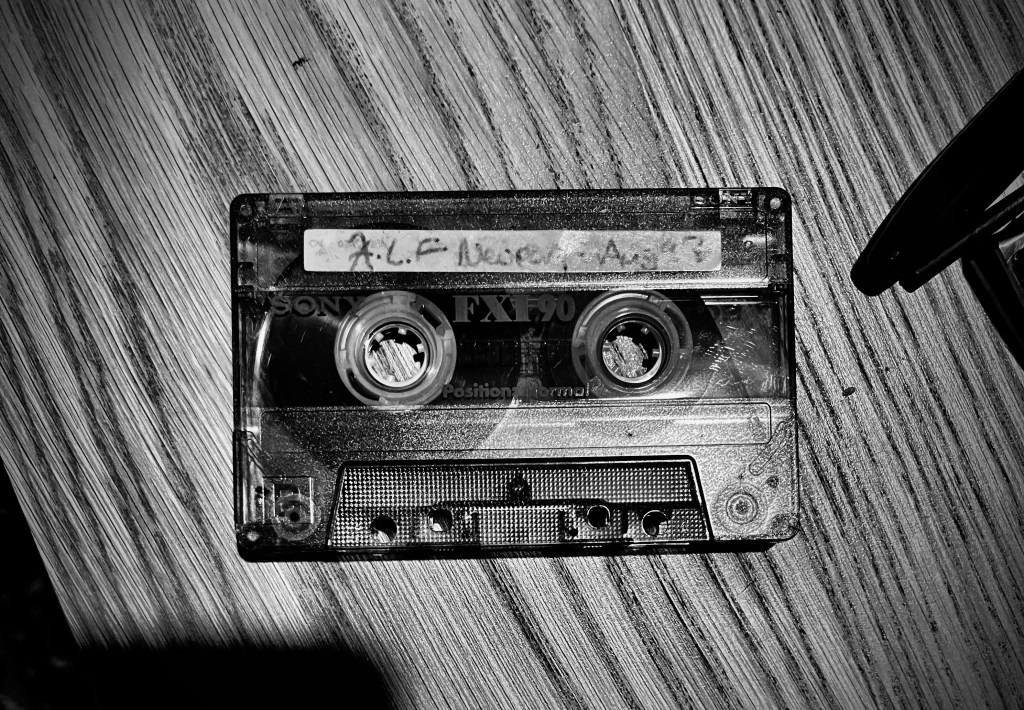
I also suspect my method will be controversial, and that some of the uses I’ve described will be unacceptable to some people. It’s ever been thus with technology. As a musician a long time ago, there was a huge backlash against the use of tech, especially in live situations, which we used to do, because we felt we could genuinely new sounds this way. We had homemade, in true punk style, t-shirts that said “Keep Music on Backing Tape” as a pushback against the “Keep Music Live” campaign at the time. Hence the title of this post.
 ALT_RANDO
Leave a comment